
Introduction
Currently, the CRS and FATCA requirements for global tax information reporting are becoming increasingly stringent, with intensified enforcement. The automatic exchange of tax-related information for tax residents of contracting countries has also formed an operational, rigorous set of standards and procedures.
Against this backdrop, a growing number of high-net-worth families and enterprises globally are choosing to invest overseas by establishing funds within the EU. By doing so, they not only gain access to global investment opportunities but also achieve investment objectives such as diversifying investment risks, enjoying comprehensive financial regulation, and legitimate tax avoidance.
Next, Oushin will provide a brief introduction to the main types of EU funds, including fund types, required financial partners, and the requirements for establishing a fund management company.
Main forms of funds in the EU (including the UK):
1) AIF (Alternative Investment Fund)
2) UCITS (Undertakings for Collective Investment in Transferable Securities)
3) Other new types of funds

1 - Main types of funds in the EU (including the UK)
AIF: Alternative Investment Fund
Since 2013, the EU has officially introduced the concept of Alternative Investment Funds, namely the "Alternative Investment Fund Managers Directive" (AIFMD).
AIF generally refers to raising funds from professional investors to invest according to a predetermined investment strategy, helping investors achieve expected investment returns.
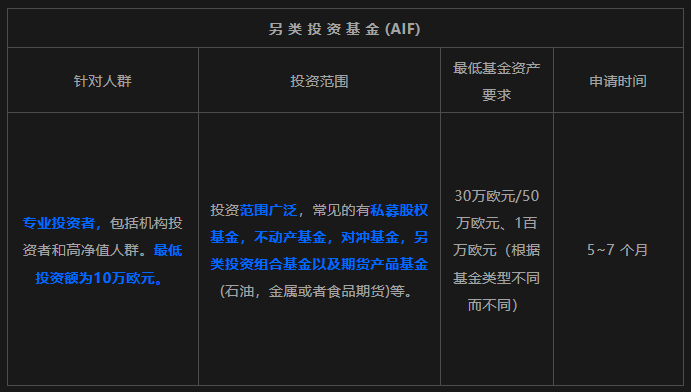
Simply put, the application requirements for AIF are relatively low, but due to the flexible investment strategy of the fund itself, the investment risk is relatively high, making it suitable for professional investors with a higher risk tolerance.
UCITS: Undertakings for Collective Investment in Transferable Securities
UCITS are generally open-ended funds that invest in transferable assets such as stocks and bonds.
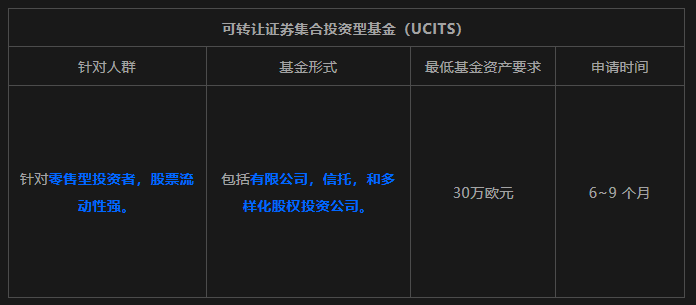
Compared to other funds, UCITS mainly target retail investors with less investment experience. Therefore, the fund has higher risk management requirements for investors, and the review is relatively stricter.
(To unify the EU's securities investment fund legislation, the EU Council formulated the "Directive on the coordination of laws, regulations, and administrative provisions relating to undertakings for collective investment in transferable securities" in 1985, known as the "UCITS Directive." This EU directive provides detailed regulations on the organization, management, and supervision of UCITS funds, clarifying rules on risk diversification, liquidity, and leverage use, aiming to maximize the protection of retail investors' interests.)
The advantages of UCITS are evident, with strong liquidity, allowing investors to buy and sell at any time, many being daily trading funds, with strict regulation and higher investor protection. However, as a result, the operating costs of the fund are relatively higher. (Simply put, each fund valuation and stock transaction is an operating expense.)
Other new types of funds
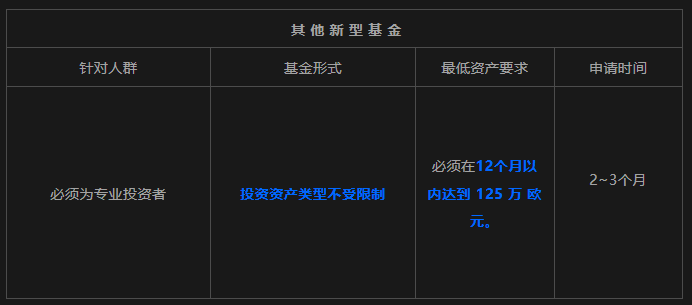
This type of fund is relatively loosely regulated, but each country has different requirements, such as Luxembourg's RAIF and Ireland's ICAV. Taking Luxembourg's RAIF as an example, this new type of fund meets the call from many alternative investment fund managers and professional investors to eliminate dual regulation, meaning that fund managers and the fund itself do not have to be simultaneously subject to regulation and supervision. Therefore, compared to ordinary funds, its overall listing time is faster, and operating costs are lower.

2 - Main partners of the fund
1. Fund Management Company
The fund management company is mainly responsible for establishing a fund that meets the client's requirements and subsequent compliance management of its operations. This means that clients only need to focus on investment decisions, while other compliance management, risk control, and related fund operations are handled by the fund management company.
Additionally, clients can choose to establish a self-managed fund, where the fund management company and the fund are the same legal entity. However, in this case, the fund management company's license cannot manage third-party funds.
2. Fund Custodian Bank
The fund custodian bank, as an independent third party, is primarily responsible for safeguarding the fund's assets and monitoring fund inflows and outflows.
3. Fund Administration Agency
Mainly responsible for the fund's administrative management tasks, including updating the shareholder register, calculating the fund's net asset value, preparing financial reports, and submitting compliance reports required by central banks. It maintains communication with financial regulatory agencies and auditors and provides them with the required information.
4. Auditor
The fund must have an independent external auditor issue an audit report annually.
5. Compliance Officer, Anti-Money Laundering Officer
Generally, fund management companies have a unified compliance officer and anti-money laundering officer, but each fund can also choose its own separate compliance officer and anti-money laundering officer.
6. Investment Advisor
Also known as the portfolio manager, usually undertaken by the investment management company, which can provide the fund with advice on investment, divestment, and reinvestment.
7. Registrar and Transfer Agent
Responsible for maintaining the shareholder register and arranging for the issuance, transfer, distribution, subscription, and redemption of shares.
8. Fund Distributor
Appointed by the fund management company, the fund distributor is primarily responsible for the fund's sales and promotion.

3 - Requirements for establishing a fund management company
◈ Register a fund company locally: The forms of fund companies mainly include private limited companies, trust companies, and open-ended investment companies. The company must have an office locally;
◈ Establish a professional management team: This includes hiring qualified licensed individuals, compliance officers, and board members. Generally, a fund management company has at least six licensed individuals;
◈ Draft relevant fund documents: Including the fund prospectus, equity subscription form, sub-fund prospectus, operational plan, and financial budget;
◈ Sign relevant service contracts with various fund service partners;
◈ Submit questionnaires for company management personnel;
◈ After submitting all application materials, provide additional information as required by the local financial regulatory authority.