
According to statistics from the Financial Conduct Authority (hereinafter referred to as FCA), 4% of adults in the UK use electronic money for payments. This figure has increased nearly 300 times over the past 20 years.
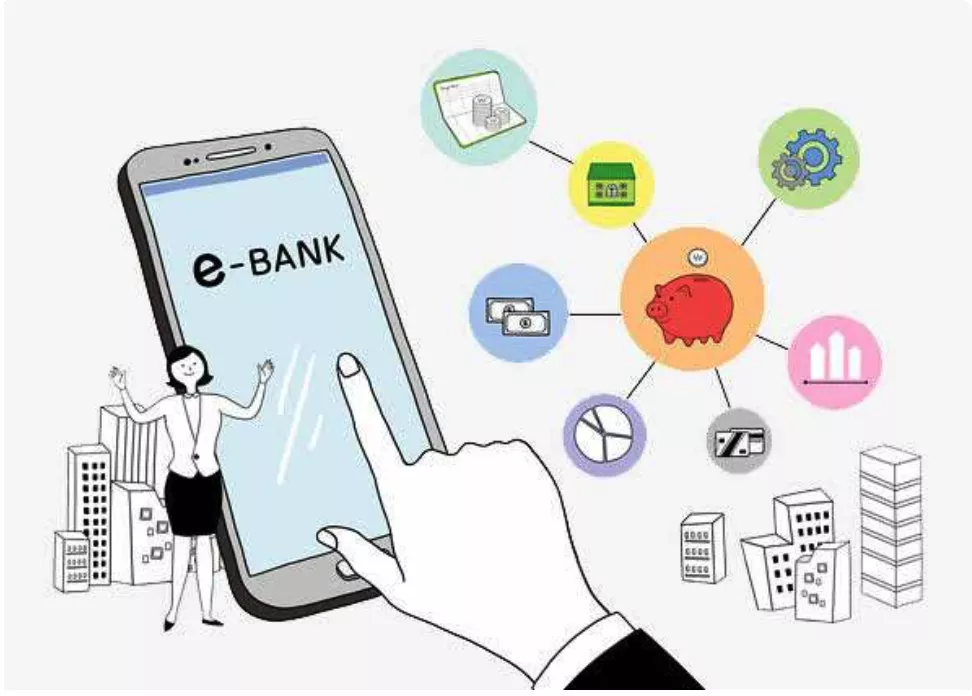
Despite the increasing use of electronic money, many people are actually unaware that they are using it.
People know very little about the difference between electronic money and bank deposits. Due to this widespread objective phenomenon, the FCA recently sent a letter to all CEOs of electronic banks, requesting them to frankly explain the differences to their customers. Next, we will provide a detailed introduction.
NO. 1|One
Unveiling the "Mystery" of Bank Deposits
Perhaps due to misleading inherent thinking, people often take it for granted that deposits mean safekeeping, entrustment, or trust. They believe they have the legal right to use the funds in their bank accounts. However, a closer look at the legal definition of deposits might surprise us.
Deposits refer to funds temporarily transferred or stored in banks and other financial institutions under the condition of retaining ownership, or the temporary transfer of usage rights to banks or other financial institutions.
In other words, banks can mix depositors' funds with their own funds, becoming their assets, and use them in the way the bank deems best.
The only condition is that they will repay an equivalent amount to the depositors.
So you won't know what your money is used for in the bank, but when you need it, the bank is obliged to return it to you. Depositors are just one of the general creditors of the bank. The funds held in bank accounts are the bank's debt to the depositors.
Because there is a certain repayment risk, central banks in each country require banks to deposit a certain proportion of funds with the central bank as a margin based on the amount of deposits they absorb. (For example, for every £10 of deposit liabilities, £1 must be held as a margin).

NO. 2|Two
What is an Electronic Bank
The commitment of electronic banks to customers is the same as that of banks:
Customers can redeem/transfer funds on demand.
But electronic money and ordinary bank deposits are both the same and different.
The similarity is: Electronic money is equivalent to bank deposits, both can be used for payments and purchases. Similarly, holders of electronic money are creditors of electronic banks.
The difference is: Banks can mix customer deposits with their own funds and use them for their own purposes, such as issuing loans.
However, electronic banks must keep customer deposits separate from their own funds. Electronic banks can also access customer funds, but they are limited to the issuance and redemption of electronic money.
As mentioned above, banks need to hold £1 of margin for every £10 of deposit liabilities. But electronic banks must hold an equivalent margin for the electronic money they issue, maintaining a one-to-one correspondence at all times.
Moreover, unlike banks and other credit institutions, the small loans issued by electronic banks must come from their own funds and must be credit generated to facilitate payment transactions, such as credit payments, and cannot be used for mortgages or other purposes.

At this point, you might wonder, since deposit-taking and lending are the main sources of income for banks, and electronic banks keep customer funds and their own funds separate, how do electronic banks earn income?
The main source of income for electronic banks comes from daily account fees, including transfer, exchange, and other handling fees. For this reason, many financial companies use electronic banking licenses as a supplementary license to support their main business, providing more convenient participation channels for non-local residents. This also diversifies their business models, such as the currently popular P2P, crowdfunding platforms, forex broker platforms, virtual currency trading platforms, etc.
NO. 3|Three
Case Assumption Sharing
The Difference Between Bank Deposits and Electronic Money
Clear and Distinct
Assumption 1: If all customers simultaneously request to withdraw all deposits.
Bank: The law allows banks to use depositors' funds for lending or investing in other financial assets. Therefore, depositors' funds are mainly supported by illiquid loans.
If all depositors simultaneously request to withdraw all deposits, without special assistance from the central bank, banks can hardly fulfill their promises. This is why, in some countries, when a financial crisis leads to a run on banks, many commercial banks go bankrupt.
Electronic Bank: If all customers suddenly request withdrawals, electronic banks can immediately meet the demand.

Assumption 2: If the bank or electronic bank where the customer deposits becomes insolvent and declares bankruptcy, will the customer suffer a loss?
Bank: Whether customers can retrieve their deposits depends on the central bank and government guarantees.
This is why bank deposits in most countries are guaranteed by the government. In the UK, the Financial Services Compensation Scheme (FSCS) provides protection for depositors up to £85,000. Beyond this range, depositors' funds will not be protected.
Electronic Bank: All customer funds of electronic banks are segregated and stored by custodian banks, and electronic banks cannot use customer funds on their own. Therefore, even in the event of bankruptcy, electronic banks can still immediately return all deposits to customers.
In conclusion: The general public finds it difficult to distinguish between these two financial concepts, and the above is only a brief description of their differences.
If viewed solely from the balance sheet, the electronic money issued by electronic banks is supported by equivalent funds (i.e., cash assets) held in segregated accounts at credit institutions.
For banks, the deposit liabilities they absorb are supported by their loans (i.e., accounts receivable), which may require assistance from the central bank for repayment if necessary.
Since most bank loans lack liquidity, borrowers may default. As general creditors of the bank, if the bank faces large-scale loan defaults or even bankruptcy, we ordinary people will suffer losses.